


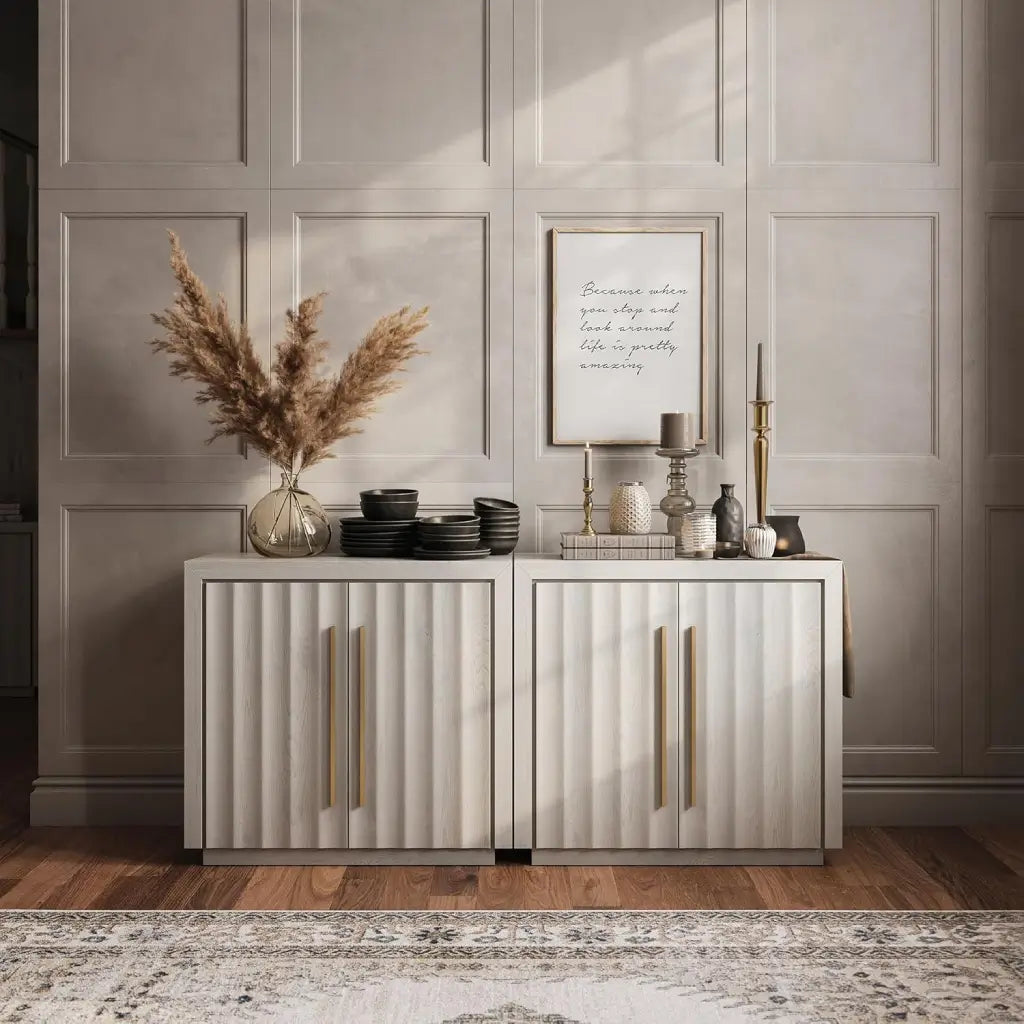
Quick Answer
- Most standard sideboards are 48 to 72 inches wide, 30 to 36 inches high, and 16 to 20 inches deep.
- In metric terms, that is roughly 122 to 183 cm wide, 76 to 91 cm high, and 41 to 51 cm deep.
- Depth causes the most sizing mistakes because a sideboard can fit the wall and still crowd the room.
Sideboard dimensions matter most when a piece looks right on paper but feels wrong once it is in the room. Most shoppers need three answers fast: the standard size range, how much clearance to leave, and which number matters most in a tight layout.
This guide starts with the common retail baseline, then moves through width, height, depth, and room-by-room fit so you can rule out bulky, cramped, or visually undersized options before you order and regret the footprint later.
Standard Sideboard Dimensions
Think of the standard range as the most common retail baseline, not a rule every room has to follow.
What size counts as standard?
Width is the wall span, height is floor to top, and depth is how far the cabinet projects into the room. Some listings call similar pieces sideboards, buffets, credenzas, or storage cabinets, but the planning logic is usually the same.
Most retail pieces cluster in the standard range below, but larger models in the mid-70-inch width range and pieces around 37 to 38 inches high are not unusual.

Sideboard size chart
This chart gives you the quickest way to sort compact, standard, and large sideboards before you compare finishes, doors, or storage layouts.
| Type | Width | Height | Depth | Metric Equivalent |
| Small or compact | 36 to 48 in. | 30 to 34 in. | 14 to 18 in. | 91 to 122 cm W, 76 to 86 cm H, 36 to 46 cm D |
| Standard | 48 to 72 in. | 30 to 36 in. | 16 to 20 in. | 122 to 183 cm W, 76 to 91 cm H, 41 to 51 cm D |
| Large | 72+ in. | 30 to 36 in. | 18 to 24 in. | 183+ cm W, 76 to 91 cm H, 46 to 61 cm D |
Standard sideboard dimensions in inches and cm
The standard width range is 48 to 72 inches, or 122 to 183 cm. Standard height is 30 to 36 inches, or 76 to 91 cm. Standard depth is 16 to 20 inches, or 41 to 51 cm, and that middle number usually decides whether the room still feels comfortable.
How Wide Should Your Sideboard Be?
Width affects wall balance first and storage second.
How wide should a sideboard be?
A sideboard usually looks best when it leaves visible wall space on both sides. A useful starting point is roughly two-thirds of the available wall width, then adjust for storage needs, nearby doors, and other furniture on that wall.
Width by storage need
Width gets easier once you match it to the job the piece needs to do.
- 36 to 48 inches works well for entry drop zones, apartment nooks, or light storage.
- 48 to 60 inches is the most flexible range for dishes, linens, board games, and everyday overflow.
- 60 to 72 inches suits longer walls, larger serving setups, and households that need more hidden storage.
For a long wall, modular sideboards often work better than forcing one fixed-width cabinet. The Jagger Modular Wood Arc-Door Sideboards (3-Piece) is a strong example, since three 32.5 inch units can span about 97.5 inches together while still giving you more layout flexibility than one oversized cabinet.
Use the example above as a modular sizing reference before comparing the sideboard with your wall length or dining table. A 2-piece modular sideboard works well for compact walls, entryways, apartments, or smaller dining areas, while a 3-piece modular sideboard fits many dining room walls that need balanced storage. For long walls, wide living rooms, or open dining spaces, a 4-piece modular sideboard can create a more complete storage-wall look.
If you're pairing it with a dining table
Use 60 to 75 percent of the table length as a rough visual starting point, not a hard rule. That usually looks balanced, but wall width and storage needs still matter more than chasing a perfect ratio.
For example, a 72 inch dining table often looks balanced with a sideboard somewhere around the mid-40s to mid-50s in width, depending on the wall and how much storage you need.
If you want the dining-only method, a clearer breakdown lives in how to choose the right size sideboard for your dining room.
What Height Actually Works?
Height changes how the top gets used and how visually heavy the cabinet feels.
Standard height of a sideboard
The standard height is 30 to 36 inches. That range works well for serving, display, and daily access without feeling too low or too tall while standing.
Lower vs taller sideboards
- 30 to 32 inches usually works better in living rooms, near sofas, or below a TV wall where sightlines matter.
- 34 to 36 inches feels better for dining rooms, coffee stations, and bar-style setups where the top gets used more often.
- Once a piece climbs well beyond the standard band, it starts to read more like a cabinet than a classic sideboard.
Why Depth Matters Most
Depth is the number most likely to ruin an otherwise good choice.
Standard sideboard depth
For most retail sideboards, standard depth falls between 16 and 20 inches. That range balances useful storage with everyday movement, which is why it appears so often in dining and living room pieces.
Depth vs walkway: what actually works
The right depth depends more on the path in front of the cabinet than the wall behind it. Closed depth is only part of the footprint because doors and drawers need room to open.
| Sideboard Depth | Works Best When | Watch For |
| 12 to 16 in. | Hallways, entries, studios | Less storage |
| 16 to 20 in. | Most dining and living rooms | Open-door clearance |
| 20 to 24 in. | Quiet walls, bulkier storage | Pinched walkways |
Slim vs deep sideboards
Choose a slimmer 12 to 16 inch profile for hallways, entry walls, and many small apartments. Go deeper only when you truly need the storage and the walkway still feels relaxed with the cabinet closed and open.
Sideboard Sizes by Room
This table gives you the fastest starting ranges by room.
| Room | Width | Height | Depth | Best For |
| Dining room | 48 to 72 in. | 30 to 36 in. | 16 to 20 in. | Dishes and linens |
| Living room | 48 to 72 in. | 30 to 34 in. | 16 to 20 in. | Display and media-adjacent storage |
| Entryway or hallway | 36 to 60 in. | 30 to 34 in. | 12 to 16 in. | Keys, bags, mail |
| Small apartment | 36 to 54 in. | 30 to 34 in. | 12 to 16 in. | Compact storage, better flow |
Dining room
Dining room sideboards usually stay in the normal height and depth range. Width is the main variable, and it should follow the wall span first, then the amount of dishes, linens, and serving pieces you need to store.
Living room
Living rooms often benefit from the lower end of the height range, especially near seating or under a TV. Standard depth still works unless the cabinet sits on a narrow pass-through, and lower profiles usually keep the screen line and the room weight more comfortable.

Entryway and hallway
In entries and hallways, start with depth before you think about width. A standard-depth cabinet can feel bulky fast, so a shallower piece usually protects flow and still gives you a useful landing strip.
Small apartments
Small apartments usually work best with widths around 36 to 48 inches and depths around 14 to 16 inches. A shallower profile protects room flow better than squeezing in the deepest cabinet you can fit on paper.
If depth is your limiting factor, sideboards for small spaces are the natural next browse path.
Clearance Rules Before You Buy
Clearance is where many paper-perfect measurements fall apart.
If the sideboard sits on a main walkway
Use 30 inches as a safe everyday walking clearance in front of the piece. Treat 24 inches as a tight minimum, and aim for 36 inches when the area should feel more comfortable, especially in dining zones.
If doors or drawers open into traffic
Functional clearance is separate from cabinet depth. Measure the room for the sideboard when it is open, not just closed, so drawers, doors, and handles do not block the path you actually use.
If the route into the room is tight
Check the narrowest doorway, tight hall turns, stair landings, baseboards, vents, outlets, and windows before you buy. A painter's-tape outline on the floor is still one of the easiest ways to see whether the footprint feels right, and packaged dimensions matter if legs or bases do not come off.
How to Choose the Right Size for Your Space
The simplest way to size a sideboard is to measure first, set your maximum depth second, and only then compare widths that still look balanced on the wall.
Start with usable wall width
Measure the span the cabinet can actually occupy, not the full wall from corner to corner. Subtract the breathing room you want on both sides, then subtract obstacles like vents, switches, radiators, or trim.
Read product dimensions the right way
Product pages may use W x D x H, H x W x D, or L x W x H. Confirm which number is depth before you assume the piece will work, because that is the number that projects into the room and causes the most regret.
If you want a concrete middle-range example, the Troy 60" Modern Sideboard Buffet Cabinet is 60 inches wide and 15.75 inches deep, which is exactly why it fits many walls without pushing too far into the room.
Match height and depth to real use
Pick height based on how you will use the top, then cap the depth based on traffic flow before comparing widths. Once those fit questions are settled, the sideboard buying guide is the better next step for style, layout, and feature decisions.
Common Sideboard Sizing Mistakes
Most sizing mistakes happen when shoppers treat width as the only number that matters. The piece fits the wall, so they assume the job is done.
Measuring width and ignoring depth
A cabinet can fit the wall perfectly and still make the room feel cramped if it projects too far into the walkway. That is the classic sideboard mistake in tighter dining rooms and apartments.
Treating standard depth as automatically safe
An 18 inch deep sideboard is standard, but that does not make it safe everywhere. In a hallway, entry, or studio, even standard depth can feel too bulky.
Door swing and baseboards add hidden depth
The usable footprint is always larger than the closed cabinet box. Baseboards can also keep the piece slightly off the wall, which makes the room-facing depth a little bigger than the listing suggests.
Going too narrow for a long wall
A very narrow sideboard may technically fit and still look visually lost. On longer or irregular walls, width should still feel intentional, which is why modular sizing helps when one fixed cabinet is not enough.

FAQ
What are standard sideboard dimensions?
Most standard sideboards are 48 to 72 inches wide, 30 to 36 inches high, and 16 to 20 inches deep. That range covers most retail listings, though smaller and larger options exist.
What is the standard height of a sideboard?
The standard height is usually 30 to 36 inches. Lower versions suit living rooms and media setups, while taller ones work better for dining, serving, or coffee station use.
How deep should a sideboard be?
For most rooms, 16 to 20 inches is the standard range. Hallways, entryways, and many studios usually work better closer to 12 to 16 inches.
How do I read sideboard dimensions on a product page?
Product pages may list dimensions in different orders, including W x D x H, H x W x D, or L x W x H. Always confirm which number is depth because that is the one most likely to cause a walkway problem.
What size sideboard works best in a small apartment?
A small apartment usually works best with a sideboard around 36 to 48 inches wide and about 14 to 16 inches deep. Protect room flow first, then take the most storage you can get within that shallower footprint.
Next Step
Once you know your maximum width, target height, and real depth limit, shopping gets much easier. Start by filtering for width, remove anything deeper than your walkway allows, then compare heights based on how you will use the top. From there, browse the main sideboards collection with clearer guardrails.


Leave a comment
This site is protected by hCaptcha and the hCaptcha Privacy Policy and Terms of Service apply.