


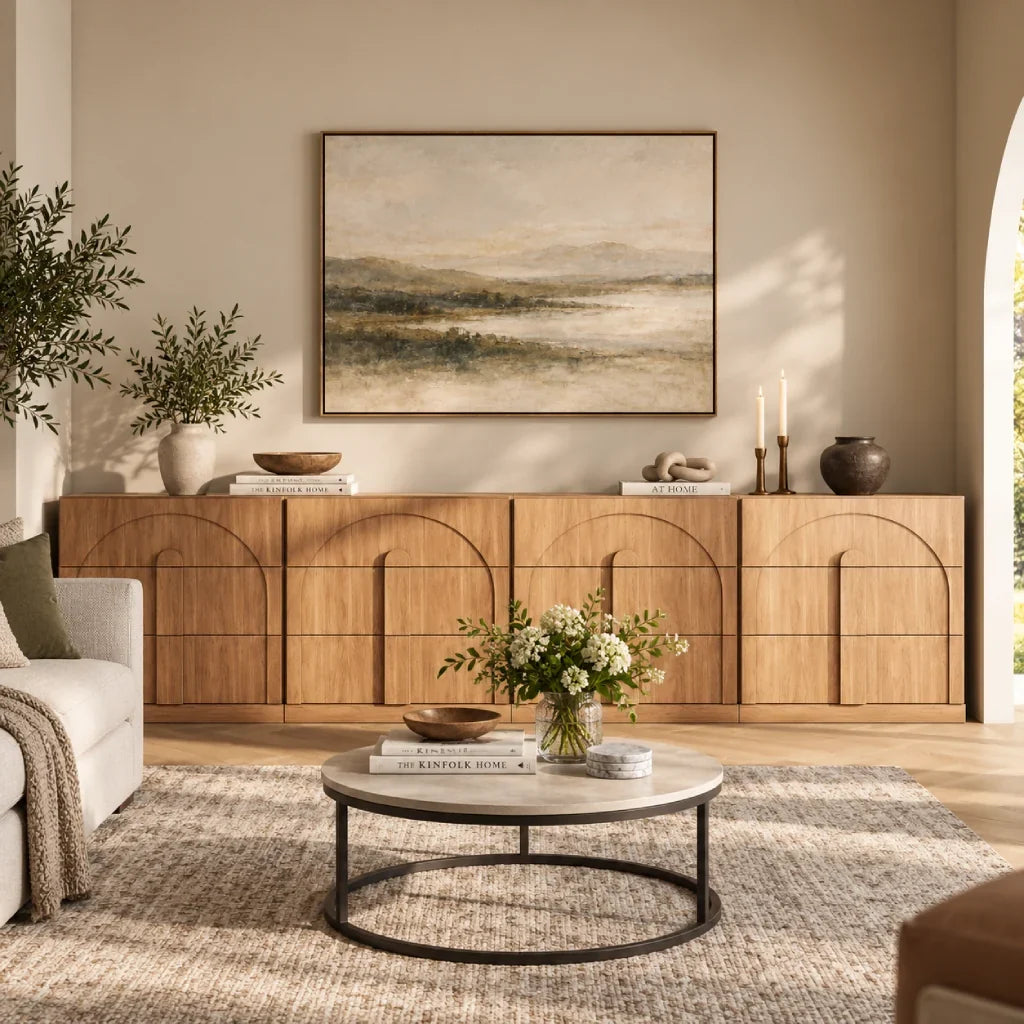
To furnish a large living room wall, decide what the wall actually needs to do, then pick one solution that fits. Scattering small pieces across a big wall rarely works. A low sideboard handles hidden storage, while a tall bookcase puts vertical space to work. A modular entertainment wall can organize a full TV setup. If storage is covered, oversized art anchors the wall without adding any furniture to the floor.
Before you buy anything, figure out whether the wall needs storage, a media setup, art, a surface treatment, or a combination. The answer depends on how much usable wall and floor space you have and whether your lease allows wall anchoring.
Figure Out What Your Wall Is Missing
Before you start shopping, walk the room and look at the wall. What actually bothers you about it? Usually it comes down to one thing. The room might have no clear visual anchor, so your eye wanders every time you sit down. You might have board games and chargers and extra blankets piling up with nowhere to put them. The TV might be sitting on a console that looks small against ten feet of empty wall. Or the wall might just be flat drywall that could use some texture.
Try rearranging what you already own before you buy anything. Slide the sofa so it centers on the wall, or shift the media console a few feet, or angle a pair of accent chairs differently. That alone fixes the balance more often than people expect.
If moving things around does not solve it, ask yourself a few questions before you shop:
- What is the wall actually missing? A focal point, a place to store things, a media setup, some surface texture, or breathing room?
- What does the wall need to sit next to? A sofa, a TV, a fireplace, a doorway?
- How much uninterrupted wall width and open floor do you have once you subtract doors, vents, switches, and walkways?
- If the answer is storage, what is the smallest piece that holds what you actually own?
- Are you renting or do you own? That decides whether you can anchor to the wall or need to stay freestanding.
Once you have those answers, pick the one solution that fills the gap.

Start With What's Already in the Room
The wall has to relate to whatever already dominates the room. If a sofa sits against it, the seating line sets your visual center. If a TV or fireplace holds the main viewing angle, the rest of the wall should back up that feature instead of fighting it for attention.
Hang artwork in relation to the furniture below it. Floating frames up toward the ceiling is a common mistake on tall walls. A useful rule of thumb: the art or art grouping should span roughly two-thirds the width of the console or sofa underneath. Hanging at seated eye level keeps the wall from feeling top-heavy.
Asymmetrical walls call for an adaptive layout. When windows, doorways, staircases, or radiators break up one side, position furniture to follow the room's natural flow instead of forcing symmetry. Matching pairs placed around an off-center opening just draw attention to the irregularity.
Measure the Space You Actually Have
Measure usable wall width, ceiling height, and available floor depth when you start shopping for furniture. The total wall span is misleading because trim, swinging doors, light switches, heating vents, radiators, baseboards, and existing furniture all eat into it.
Depth matters as much as width. A cabinet can look well-scaled against the wall but choke off foot traffic when you open it. Make sure cabinet doors, pull-out drawers, and nearby interior doors can swing fully without hitting the coffee table, catching on an area rug, or bumping into someone on the sofa.
Tape out the proposed furniture dimensions on both the floor and wall with painter tape before you buy anything. Living with the tape outline for a day or two makes it much easier to judge scale and spot circulation problems. You can review how to measure a room for furniture for help confirming comfortable walkways and locating studs for anti-tip anchoring.
Pick the Right Storage Piece
Storage furniture comes in three scales: a single low piece, a tall unit, or a full wall of coordinated cabinets. The right one depends on how much you need to store and how much wall and floor space you can give up.
A Low Sideboard
A low sideboard grounds a wide stretch of wall and leaves the space above it open. Board games, dinnerware, extra linens, and electronics disappear behind cabinet doors, so the room's perimeter stays clean. The low profile covers a wide span without the heavy vertical presence of a wardrobe or tall shelving unit.
If your layout has room for standard cabinet depth and you want a focal point beneath framed art, explore sideboards for long walls. Follow the manufacturer's assembly guide and anchor the back to wall studs to prevent tip-over.
A Tall Bookcase

Tall open shelving works in rooms that need vertical balance and dedicated book storage. A bookcase pulls the eye toward high ceilings without eating up the deep floor footprint of an enclosed wardrobe. If book or display storage is what the wall needs, compare tall bookshelves and bookcases after checking wall width and ceiling height.
Check ceiling clearance and baseboard profiles before bringing tall shelving into a living area. Tall units look heavier in narrow rooms, so make sure the room is wide enough that the bookcase does not crowd the space. Fasten every tall bookcase directly to wall studs with the manufacturer's anti-tip hardware.
A Full Storage Wall
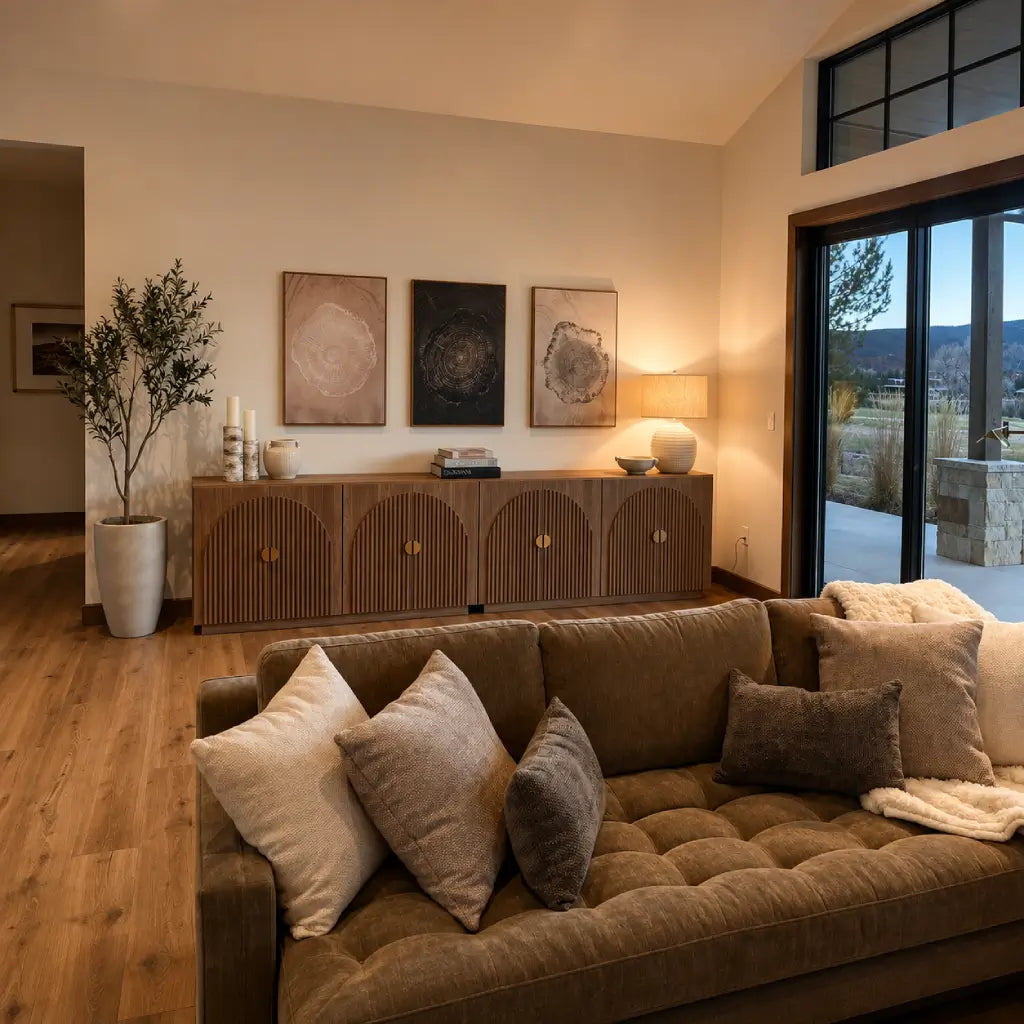
A multi-unit storage wall makes sense when a single cabinet cannot hold everything you need to store and the room has enough wall width and floor depth for a full run of units. If you need expandable storage across a wide living room wall, compare modular cabinets after confirming the total dimensions of the configuration.
A full storage wall commits a lot of floor space and makes rearranging harder, so it works best when you have enough to fill it. Families with large book collections or mixed media and storage needs get the most out of this setup.
Go Modular When the TV Runs the Show
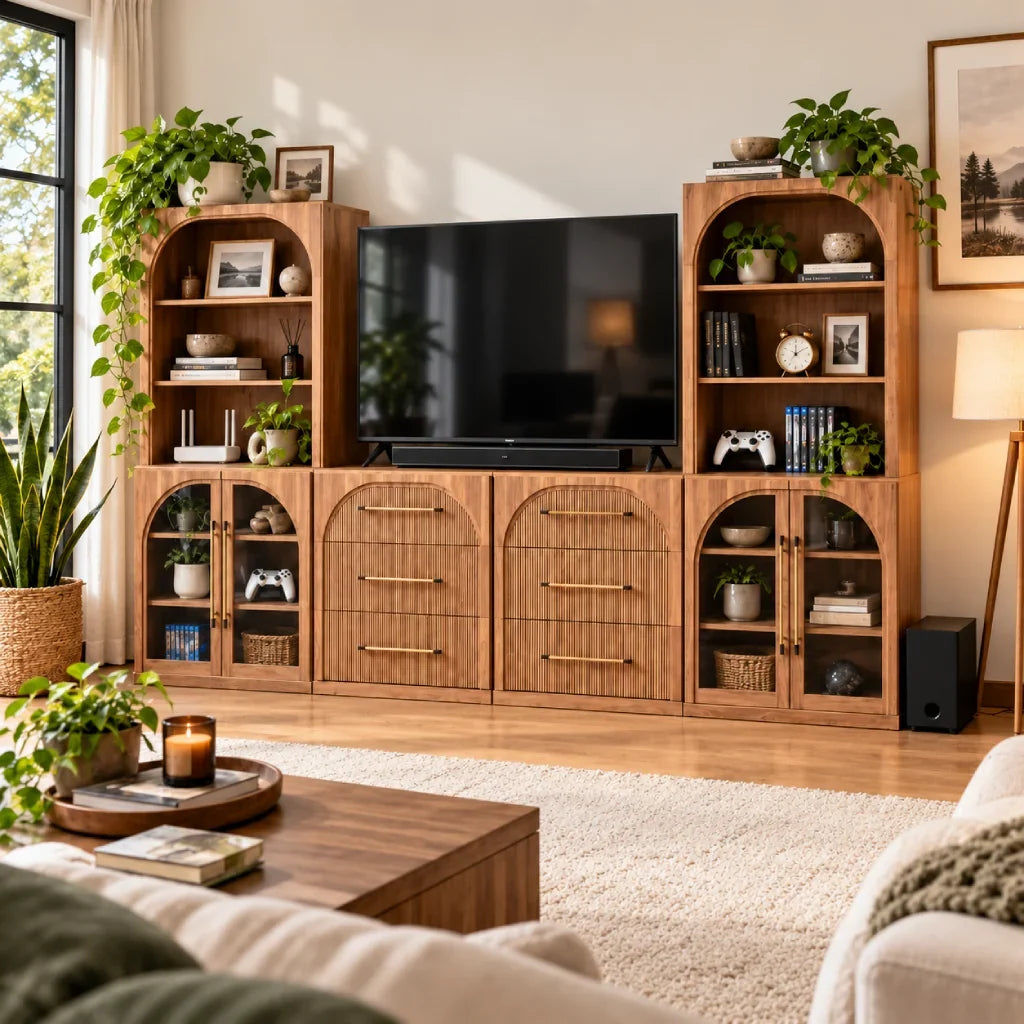
A modular entertainment wall makes sense when the TV is the main focal point and the same wall also needs media storage, display shelving, or more visual structure. If a standard TV console falls short on storage or wall coverage, compare modular entertainment centers before picking a configuration.
Once those needs line up, modular systems let you organize media equipment across a wide wall without custom millwork. The Jagger 6-piece modular TV stand with double arc wood door and hutch cabinet pairs wood-door sideboards with hutches and open display. The Bijou modern arched entertainment center wall unit 4-piece combines tall open-and-door storage with lower drawer units.


Check that your floor is level and the wall structure is solid before ordering multi-piece modular units. Sections on an uneven floor will show gaps between pieces or doors that hang crooked. Renters should verify stud locations and lease restrictions, since multi-piece assemblies need anti-tip wall anchoring.
Use Art or a Wall Treatment Instead
When the wall needs presence but not furniture, art or a surface treatment is the answer. One oversized painting or a tight grouping of framed prints gives the wall a focal point without eating any floor space. Size the art to relate to the seating or console below, and it will anchor the wall without crowding the walking path.
Surface treatments bring character to a large stretch of bare drywall. Accent paint, textured grasscloth wallpaper, vertical wood slat paneling, or applied picture-frame molding all add depth to the wall. Renters can try removable wallpaper or hung tapestries; homeowners can go with permanent millwork.
You will know the wall is done when it has one clear focal point and the rest of the surface reads as intentional space. That clean contrast between the focal point and open wall is what makes a large wall look intentional.

Leave a comment
This site is protected by hCaptcha and the hCaptcha Privacy Policy and Terms of Service apply.