


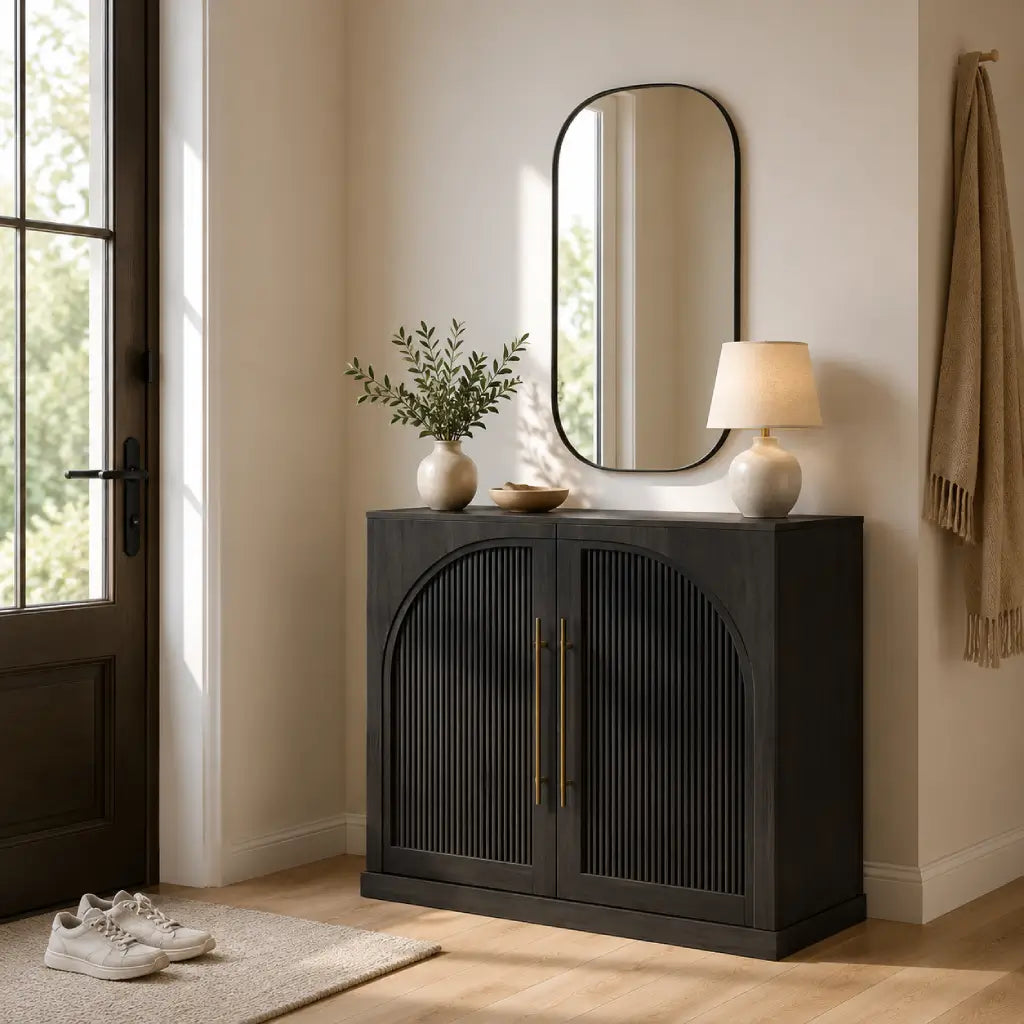
Shoes make an entryway look messy when too many pairs end up by the door. A bigger cabinet helps only after you cut the shoe count, give wet shoes a place to dry, and choose storage by depth, door swing, and walkway clearance.
For most homes, the choice comes down to a slim shoe cabinet, a bench, a drying tray, a closed cabinet, or a sideboard used with care.
Diagnose the pile before choosing furniture
Before choosing a cabinet, decide which problem you are solving. A messy entry often has one of four causes:
- Too many shoes are parked by the door, so overflow needs to move elsewhere.
- The hallway is too shallow for deep furniture, so depth matters before style.
- Wet shoes are mixing with dry shoes, so the entry needs a drying spot first.
- The storage is too hard to use during a rushed morning.
If those problems are under control and the entry has a wider wall, closed storage can work. Measure the walking path and door swing before treating any cabinet as the answer.
Decide which shoes stay by the door
Most entryways work best with 1 to 2 dry daily pairs per person near the door. More than that can overwhelm a cabinet, basket, or bench, even when the furniture looks roomy online.
Sort the shoes before you buy furniture. A storage cabinet can hide shoes, but it cannot make rarely worn shoes belong in a busy entryway.
Everyday dry shoes
Everyday dry shoes belong in the main hidden storage because they need fast access. Keep sneakers, flats, school shoes, and work shoes there when they fit the cabinet depth and shelf height.
Use the 1 to 2 pair rule for busy mornings. A system that needs careful arranging every day tends to fail.

Wet shoes need to dry first
Wet, muddy, or sweaty shoes should not go straight into the main cabinet, bench, or sideboard. Let them dry on a tray, washable mat, or boot zone first.
Closed storage hides clutter, but it can trap dampness and odor when shoes go in too soon. Let shoes dry first, then hide them.
Shoes that should move elsewhere
Formal shoes, sports shoes, off-season pairs, and rarely worn footwear should move to a closet, bedroom rack, garage shelf, or under-bed bin.
Some homes look cleaner with almost no entryway shoe storage. In that setup, the entry holds one active pair per person, and the real shoe storage lives elsewhere.
Compare hidden shoe storage options
Use this table to choose the starting storage type. Product pages still control pair capacity, shelf fit, and weight limits. Wet shoes should dry on a tray or mat before they move into hidden storage.
| Entry problem | Start with | Skip it when |
| The hallway is narrow or rented | Slim shoe cabinet, wall organizer, or over-door storage | You need boot storage or cannot keep the walking path clear |
| You need a place to sit | Storage bench with one small zone per person | Your entry needs to hold more than daily shoes |
| You have enough wall width | Closed-door shoe cabinet for dry daily shoes | The door swing, shelf height, or walkway clearance fails |
| You want furniture-style storage | A sideboard only if dry shoes fit the usable shelf depth | You need shoe-specific ventilation, boot storage, or guaranteed pair capacity |
Decide how hidden the shoes need to be
Closed storage hides the visual noise: mixed colors, soles, laces, and uneven shoe shapes. Choose it when the entry opens into a living area or sits in plain view.
Open storage still earns a place near the door. Use it for wet shoes, guest shoes, or family routines where speed matters more than hiding the shoes.
For dry daily shoes, opaque doors are more forgiving than glass. Glass doors are fine for baskets or display, but they show too much when the cabinet holds everyday shoes.
For narrow hallways, go slim
A narrow hallway needs shoe storage that protects the walking path. Start with a slim shoe cabinet, wall-friendly organizer, or over-door solution before considering a deeper cabinet.
Slim storage hides shoes better than an open pile, but it is weaker for tall boots, bulky sneakers, and large-family storage.
Renters who cannot drill
Renters should check freestanding slim cabinets, over-door organizers, rolling racks, or movable storage before wall-mounted systems. Review stability notes and assembly requirements before treating a piece as renter-friendly.
A storage piece is not renter-friendly just because it stands on the floor. If you cannot use recommended anchoring hardware, choose a lower, wider, lighter-duty option instead of relying on an unsecured tall cabinet.
When the door opens into living space
A closed cabinet can create a small entry zone when the front door opens straight into a living area. It gives shoes one place to go, so they do not creep into the living room.
This works only if the cabinet does not crowd the door path. In a tight living-entry layout, a slimmer shoe cabinet may work better than a deeper sideboard.
Use a bench for daily shoes only
An entryway bench is for daily shoes, not every pair in the house. It works best when each person gets one zone and only current shoes stay there.
Families should use labeled baskets or one cubby per person. Children need low zones they can reach without help, or shoes will land on the floor during busy mornings.
A bench that overflows after each person gets one zone is not too small. Too many shoes are living in the entryway.
Use closed storage only when the path works
A wider wall can handle closed-door storage only if the path stays clear. Choose this route when open racks make the entry look busy and the cabinet will not crowd the door.
Start with one cabinet. Add a second piece only when wall width, daily shoe count, and clearance justify the footprint.
Check stability before expanding
Add another modular piece only if the floor is level, the pieces sit evenly, and the walkway stays clear. Use anti-tip hardware or wall anchoring when the product page or manual recommends it.
Homes with children, pets, heavy bags, uneven floors, or frequent door traffic need a stricter safety check. Avoid tall, top-heavy, or stacked storage in those spaces unless it can be secured according to the product instructions.

Check whether a sideboard can fit shoes
A sideboard is designed primarily for dining or living-room storage, not shoe ventilation. Treat it as a shoe option only if the shelf height, usable depth, and airflow work for dry daily shoes.
A sideboard can store shoes only if it passes shoe-specific fit checks. Measure exterior depth, door swing, internal shelf depth, and shelf height before ordering.
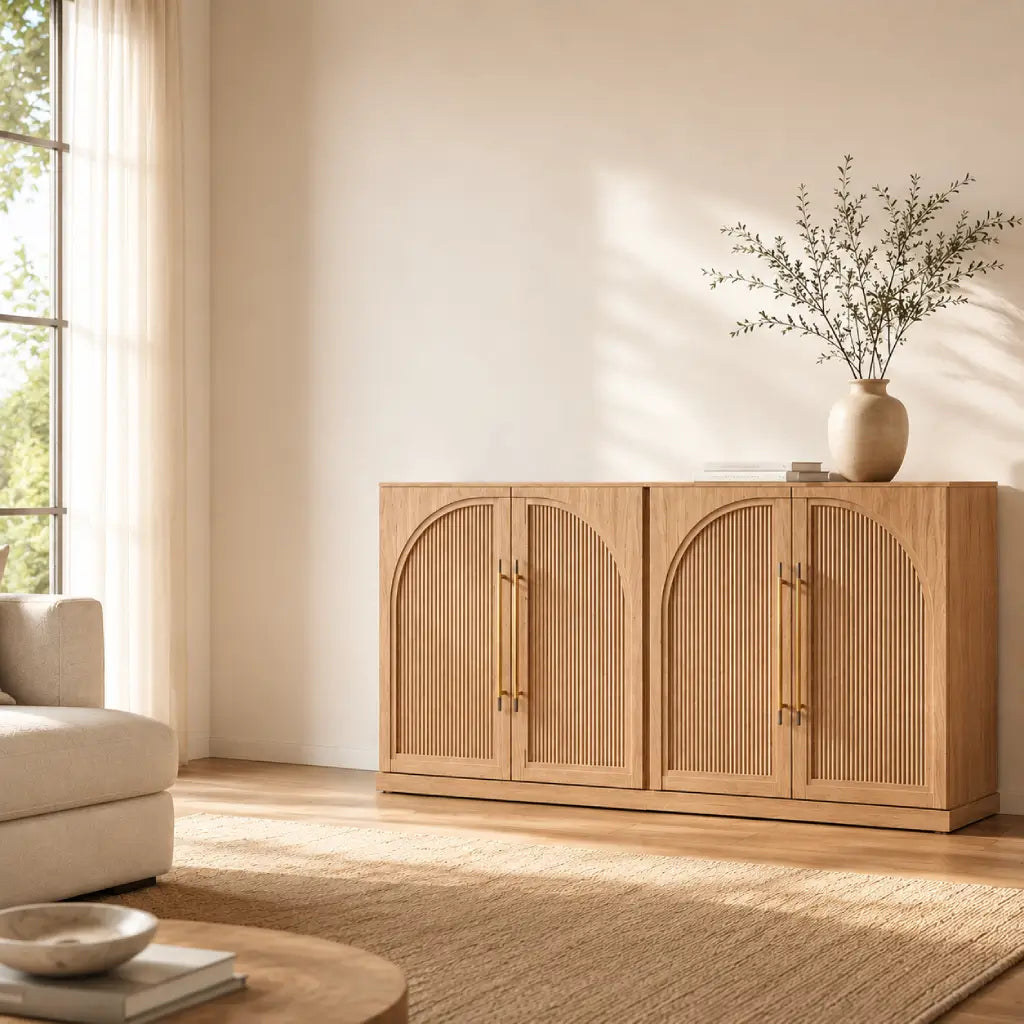
Treat Belleze sideboards as fit examples, not guaranteed shoe-pair counts. The 33" Modern Modular Sideboard with Arched Fluted Doors lists 15.7"D x 32.7"W x 31.7"H and adjustable shelves.
That depth is an exterior dimension, so shoppers should still confirm usable interior shelf depth, door clearance, and shelf height before using the piece for shoes. Check the listed weight capacity, material field, and assembly notes before placing heavy items on top or storing damp shoes nearby.
Measure the path, not the wall
A cabinet can fit along the wall and still make the entry harder to use if it takes up too much walking space. About 30 inches of clear walkway is a practical planning target, not a building-code claim.
A 16-inch-deep cabinet in a 46-inch-wide hallway leaves about 30 inches before door swing, drawer pull, trim, or baseboards. A slimmer shoe cabinet may be the better choice when the entry is already tight.
Mark the cabinet width, depth, open-door swing, drawer pull, and front-door movement with painter's tape. Check whether baseboards push the cabinet forward. Belleze's modular sideboard measuring checklist can help before ordering a wider storage piece.
Do not move the mess to the top
A clean shoe cabinet can still collect clutter on top. Limit the surface to one tray or bowl for essentials and one vertical object, such as a lamp or vase.
Returns, mail, bags, and sports gear need another destination. Use the top of the cabinet for quick drop-offs, not long-term storage.
Choose the next piece by constraint
Edit the shoes first, dry wet pairs before hiding them, then choose storage by depth and routine.
Tight, shallow, rental, or no-closet entries should start with compact entryway cabinets and check depth, door clearance, shelf fit, and anchoring notes before ordering.
If the taped footprint still leaves a comfortable path, a wider entry can handle closed-door furniture storage. Compare entryway modular sideboards after checking shelf fit, usable depth, and door clearance.
After those checks, use a specific product page such as the Bijou Arched Wood Doors Modular Sideboard as a comparison example. Check its 16.3"D x 31.5"W x 31.5"H exterior size, interior shelf layout, and current product-page details against your shoe routine before deciding.
FAQ
How many shoes should you keep in an entryway?
Keep 1 to 2 dry daily pairs per person in an entryway. Move seasonal shoes, formal shoes, sports shoes, and rarely worn pairs to a closet, bedroom, garage, or under-bed storage.
Can a sideboard store entryway shoes?
Yes, if the sideboard leaves enough walkway clearance and the interior shelf depth and height fit your daily shoes. Use it for dry shoes only, and do not assume pair capacity unless the product page states it. A sideboard also needs enough airflow because it is not a dedicated shoe cabinet.
How do you prevent odor in hidden shoe storage?
Do not close wet shoes inside furniture. Let them dry on a tray, washable mat, or boot zone first, then move them into hidden storage. Use a removable liner or odor absorber in high-use zones, and clean out grit before it scratches or stains interior surfaces.

Leave a comment
This site is protected by hCaptcha and the hCaptcha Privacy Policy and Terms of Service apply.