


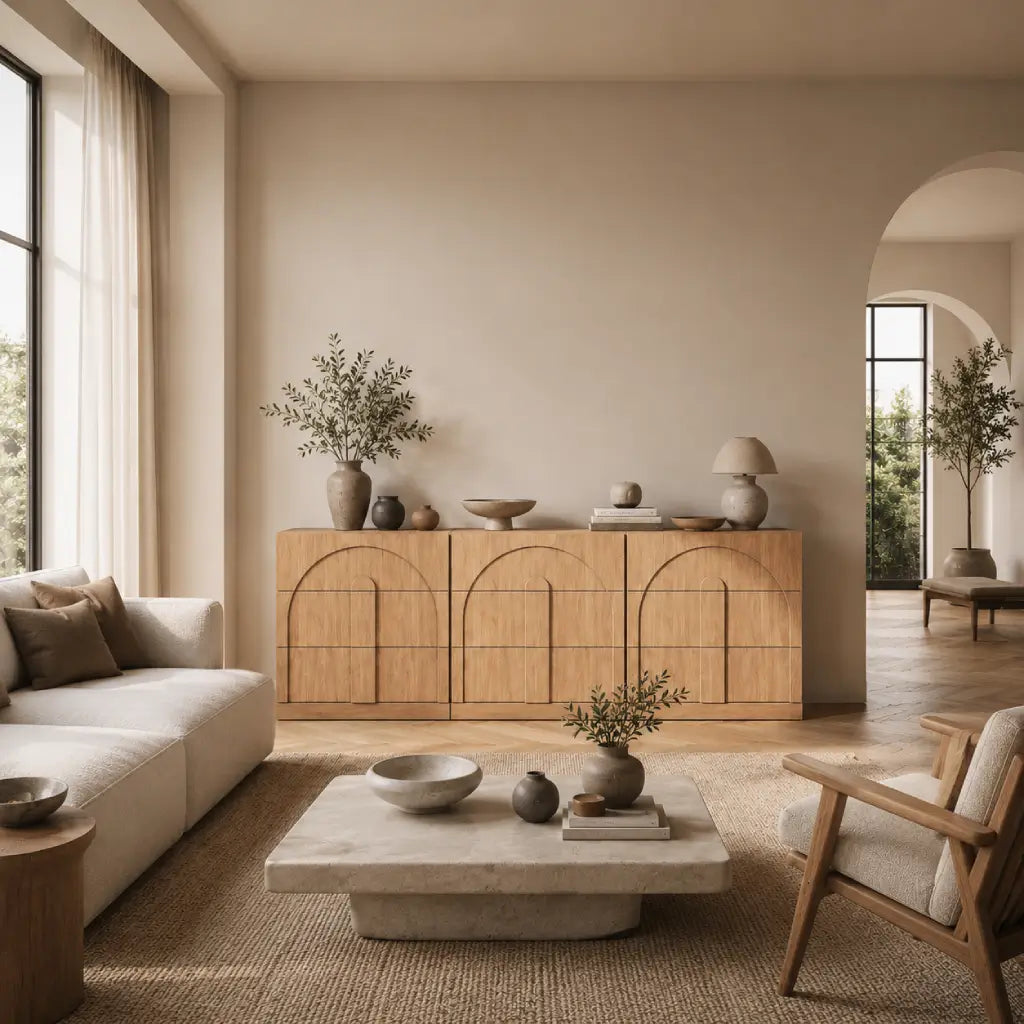
Most people shopping for a sideboard in an open living-dining room start with the cabinet. They pick a finish, measure the wall, and hit buy. A week later they realize it blocks the walking path, leaves the dining chairs nowhere to go, or looks too small on a twelve-foot wall.
Start with the room problem, then choose placement, module count, and door style. Put the sideboard near the dining wall for serveware, on the living side for visible clutter, or on a shared wall when the room needs one visual anchor. For many open living-dining rooms, 3 pieces is the lowest-risk first option; drop to 2 when traffic is tight and move up to 4 only for a long wall.
Start With the Storage Problem
Before you measure a wall, decide what the cabinet has to fix. In an open living-dining room, the wrong sideboard usually fails for one of three reasons: it blocks traffic, stores the wrong things, or looks disconnected from both zones.
| If the room problem is... | Start with this cabinet route |
| Dishes, linens, or serveware have no home | A sideboard or buffet cabinet on the dining wall |
| Living-room clutter is visible from the table | A closed storage cabinet on the living-side wall or behind the sofa |
| The living and dining zones feel disconnected | A modular cabinet system on a shared wall or soft boundary line |
| A long wall feels unfinished | A wider modular sideboard that works as a low anchor |
| The room already feels tight | A 2-piece setup, narrow console, or no sideboard at all |
A sideboard is not always the answer. If movement already feels pinched between the sofa and dining table, a narrow console with baskets may work better than a full sideboard run. If you have a clear wall, a real storage gap, and enough walking room, a modular sideboard adds closed storage without blocking sightlines.
When the Dining Area Needs Storage
When the cabinet's main job is serving dinner, keep it close to the table. A dining room modular sideboard works best here because it gives dishes, linens, serveware, barware, and a landing surface one place to live. A 3-piece setup is often the right middle size because it anchors the table without turning the wall into a storage wall.

Before you commit, pull a dining chair all the way out and mark its full arc on the floor with tape. Then tape the cabinet depth, door swing, and drawer pullout. If the two taped zones overlap or leave no comfortable route behind a seated person, move the sideboard or drop down a module count.
Do not assume the top or shelves can handle heavy appliances, dense stacks of plates, or aquariums. A countertop coffee maker, a loaded wine rack, or stacked cast-iron can exceed what a decorative storage cabinet is built to hold. Check the product page for the exact top, shelf, and drawer weight limits.
Need a tighter fit check around the table? Our dining room sideboard size guide walks through table, chair, and wall clearance in more detail.
When Living Room Clutter Is the Problem
Open plans have a storage problem: fewer walls, fewer places for cabinets. Everything left out on the living side is visible from the dining table. A sideboard on the living side hides remotes, chargers, throws, kids' toys, games, books, and whatever piles up by Thursday.
In a compact living-dining combo, the goal is storage that does not make the room feel heavier. A living room modular sideboard can work because it hides the daily mess behind closed doors instead of adding more open shelves. Here, closed doors usually beat open shelves. Open shelves in a living area visible from the dining table look like clutter unless you style and maintain them.
If the living side is wider or you host often, do not lock into 2 pieces yet. The right count depends on the full wall, not just the first storage problem you notice.
When the Room Needs One Anchor
Some open rooms have enough storage but still feel unfinished. If the sofa, table, and long wall all compete for attention, a low sideboard gives the eye one clear place to land.
Place it on a shared wall when the dining table and sofa relate to the same long wall. Set it behind the sofa when the sofa back feels exposed. Let it run along a long blank wall when that wall needs to do more than sit empty.
A console table marks the same boundary with almost no closed storage. A tall divider blocks light. A low sideboard says "dining ends here, living starts there" without chopping the room up.
Modular sideboards work for this job because you can size the run to your wall instead of hoping a single fixed cabinet fits the room well.

How Many Sideboard Modules Fit?
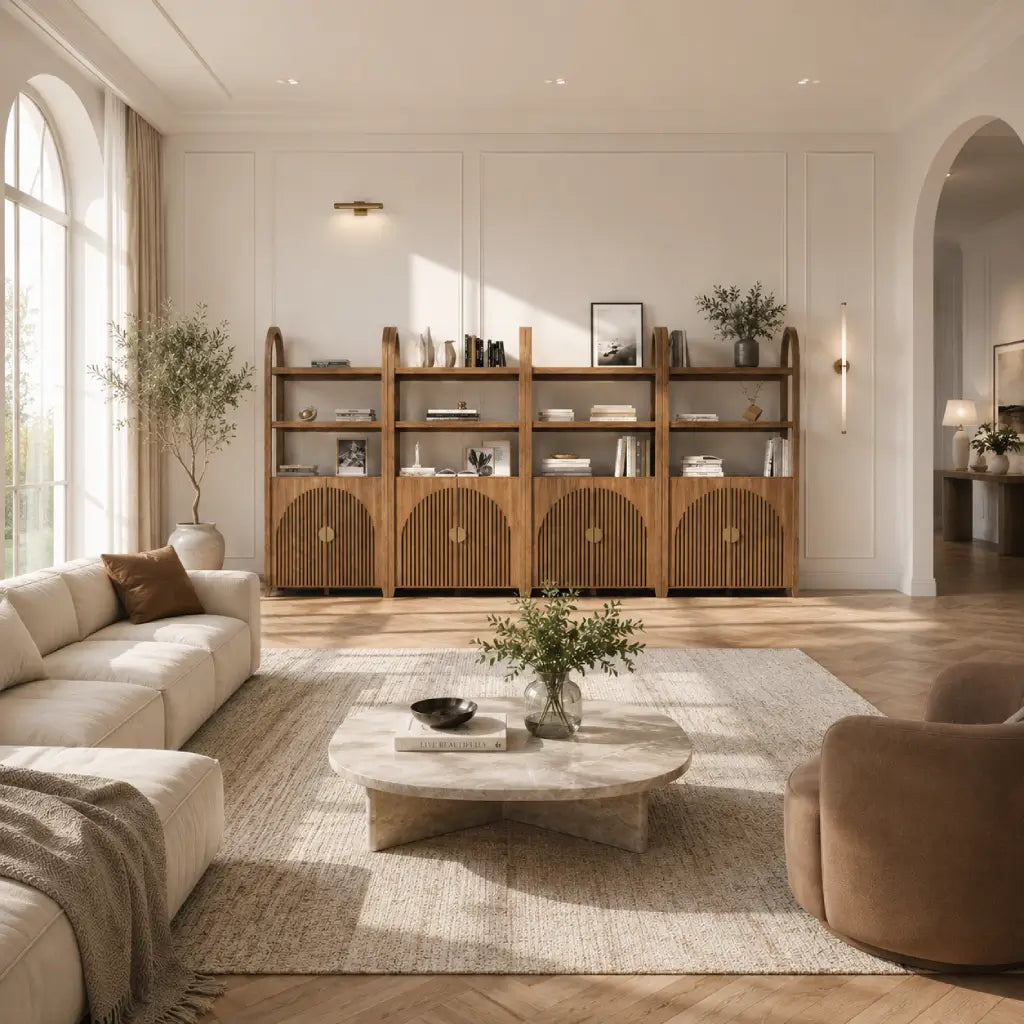
More pieces do not make a better room. Four pieces can overwhelm a short wall. Two pieces can look lost on a long one. Pick the smallest count that anchors the room and handles the storage.
Check the exact width of each module in the product series you are considering. As a planning shortcut, multiply one module width by 2, 3, or 4, then add breathing room on both ends. A few extra inches can change chair clearance or make a run feel squeezed.
| Module count | Best fit | Skip it when |
| 2-piece | Compact rooms or one clear storage problem | Looks undersized if the run is much shorter than nearby furniture or the wall span |
| 3-piece | Most dining walls, shared walls, and open-room anchors | Still needs enough wall for the run plus chair clearance on the dining side |
| 4-piece | Long uninterrupted walls that need a low storage wall | Overwhelms compact rooms. Do not buy four pieces just because the wall is empty. |


Treat the table as a first pass, then test the size against your actual wall and chair clearance. If a 3-piece run gives the room a clear anchor without taking over the wall, start there. If it makes the furniture plan feel crowded, drop to 2. If it looks stranded on a long wall, compare it with a 4-piece modular sideboard before ordering.
Choose Doors and Drawers by What You Store
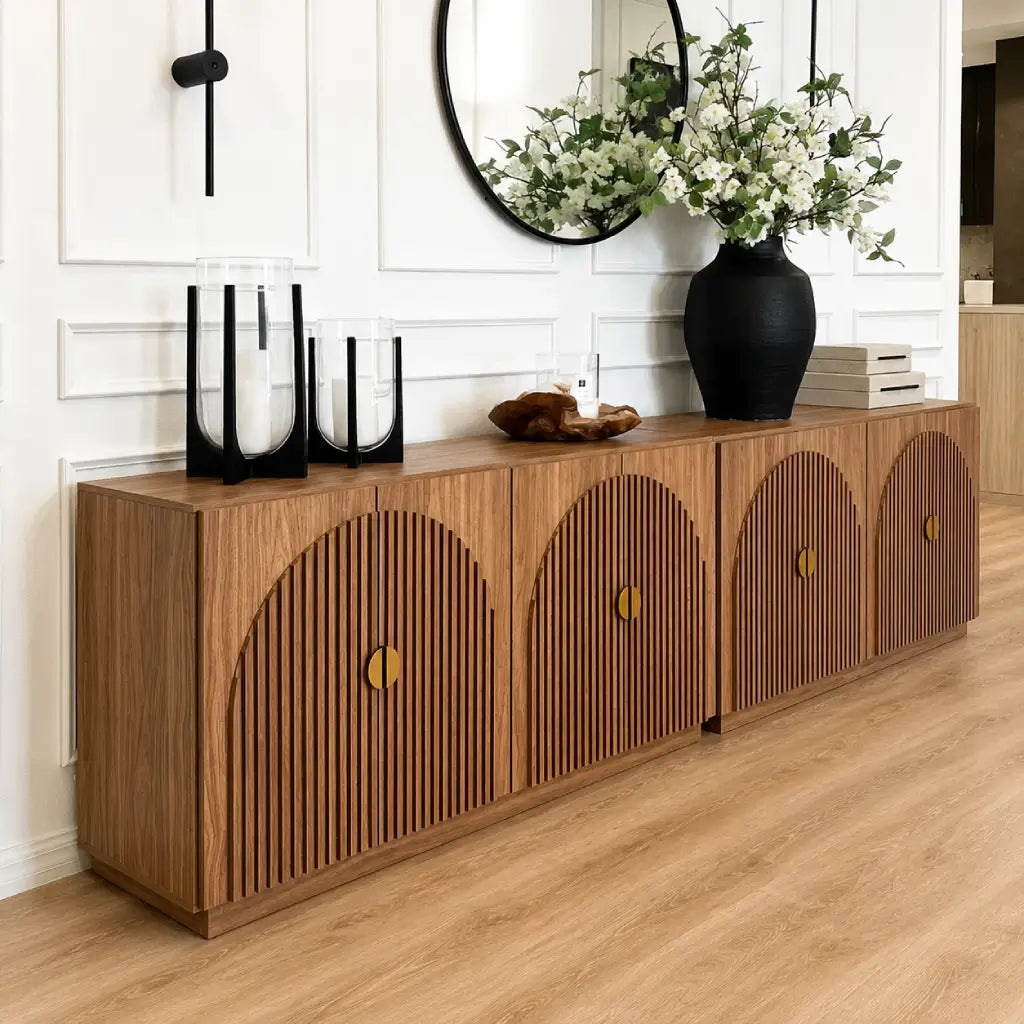
Do not choose the front style from the product photo alone. Choose it by what you need to hide, show, or grab every day. If the cabinet will face the dining table every day, closed wood doors are usually the safest choice. Glass works when you actually want to display barware or serving pieces. Drawers make sense for small loose items, not big serving bowls.
Mixed fronts work when one run does two jobs. Cabinets near the dining table can show glassware and bar tools. Cabinets near the sofa should hide the things guests do not need to see. If you cannot name what lives in each cabinet, default to wood doors.
Check These Before You Order
Keep the Walkways Open
Mark the cabinet footprint on the floor with painter's tape, depth included. Walk every daily route: kitchen to table, table to sofa, sofa to doors. If any path feels narrow, the run is too deep, too long, or in the wrong spot.
Check Baseboards, Vents, and Outlets
Baseboards can keep a cabinet from sitting flush. Floor vents under the cabinet block airflow. Outlets can end up hidden behind a back panel. If you need to run a cord from inside, look for a cable pass-through. Verify baseboard cutouts, leg height, and outlet access in the product specs.
Make Sure You Can Anchor It
Anchor every section to the wall using the included anti-tip hardware, especially in homes with kids, pets, or heavy drawer use. The U.S. Consumer Product Safety Commission recommends securing furniture to the wall to reduce tip-over risk. Match the hardware to your wall type, and do not use an unanchored cabinet as a support surface.
One last install check saves a lot of frustration. Before assembly, check that the floor is level across the full run. Uneven floors can create gaps between modules or make drawers misalign. Keep veneer or laminate finishes away from prolonged moisture and direct sun. For a multi-piece setup, plan on a second set of hands. Modules ordered from different batches may show slight finish variation. For a broader measurement checklist, use the sideboard dimensions guide.
Choose the Sideboard Setup That Fits
Once you know where the sideboard can live without fighting the room, the buying decision gets much easier: choose the width that protects traffic first, then pick the front style that matches what you actually store.
From there, let the room set the count. Two pieces should solve a compact storage problem. Three should feel like a complete dining or shared-wall anchor. Four should earn its size on a long wall, not just fill empty space.
If you are between two sizes, choose the one that protects the room's daily flow. Extra cabinet space is useful only when chairs still pull out, drawers still open, and the route between kitchen, table, and sofa still feels natural. That order keeps the purchase tied to the room, not just the product photo.

Leave a comment
This site is protected by hCaptcha and the hCaptcha Privacy Policy and Terms of Service apply.