


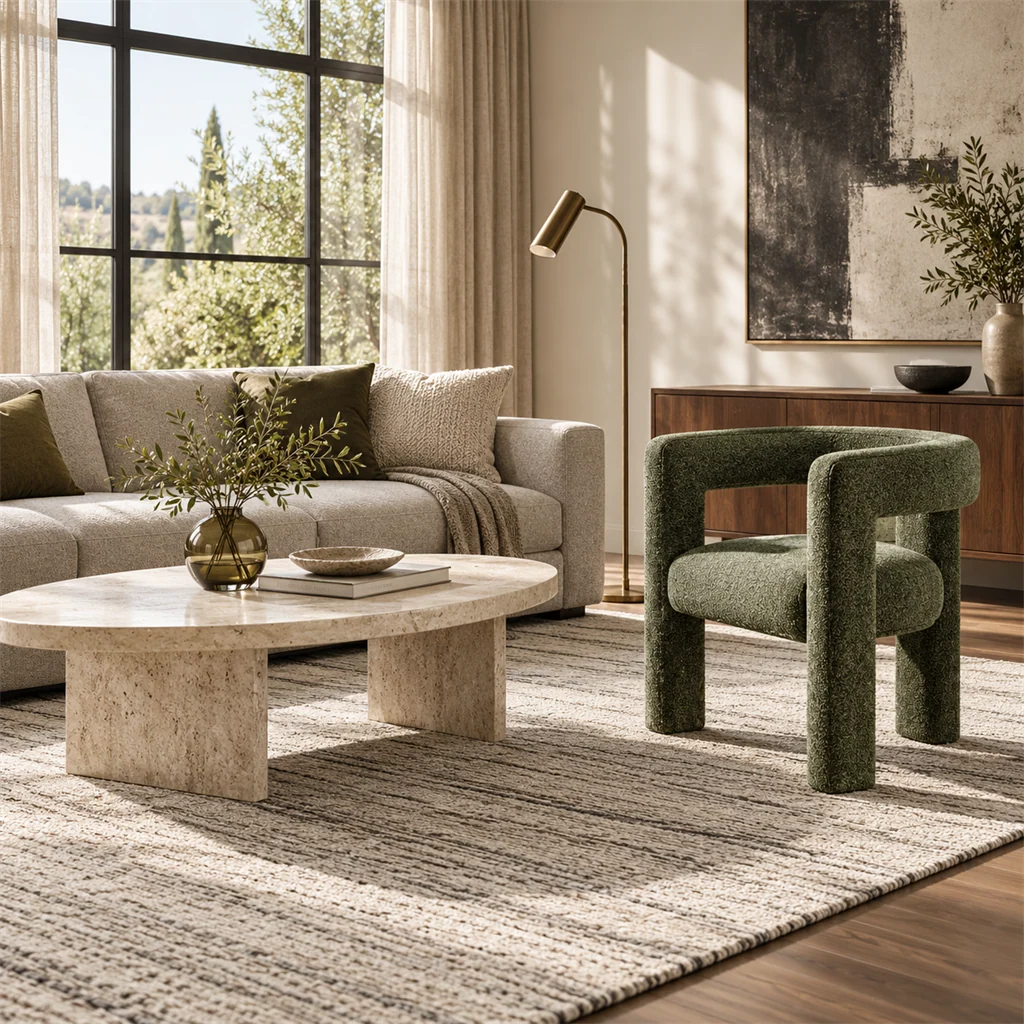
The easiest place to start is right beside the sofa. Putting the chair perpendicular to the couch pulls a guest right into the conversation, provided you leave enough room to walk past the sofa arm. If that side path feels tight, placing the chair across from the sofa, into a quiet corner, or along the edge of an open floor plan works much better for everyday foot traffic.
Beside the Couch: The Go-To Conversation Spot
Setting your chair perpendicular to the couch creates an instant, natural conversation area. Angling the seat slightly inward lets you talk without craning your neck, while keeping the center of the rug open for a coffee table. The main thing to watch is the walkway past the sofa arm. Shoving the chair too close boxes in whoever sits there, but pushing it too far out crowds the doorway path. You should be able to walk past the sofa arm comfortably without having to turn your shoulders sideways.
If space is tight, a curved back makes moving around much easier. The Highland small spaces barrel chair measures 26.5 inches wide by 22.7 inches deep, and its rounded back has no sharp corners to bump into as people walk past. Leave about twelve to fourteen inches between the seat and coffee table so guests have knee room to sit and stand comfortably.
Across from the Couch: One Chair or a Pair?
Placing seating opposite the sofa balances out a long couch and frames the conversation area. A single chair is easy to position because it leaves open floor on both sides, letting you angle the seat without pinching walkways. A pair creates a balanced, symmetrical look, but takes up far more floor space. You have to account for the width of both seats, an accent table between them, and walking room around the outside arms.
You can see the math with the Allston high-back accent armchairs (set of 2). Each chair measures 29.1 inches wide by 29.3 inches deep, so two side by side take 58.2 inches before leaving any gap. Put a fourteen-inch table in the middle, and the setup spans over six feet wide. Angling them inward makes conversation easier, but flares their rear corners out and eats up more depth. If that footprint crowds your walls or doorways, stick with one chair.
Have a Sectional? Start with the Open Side
Sectionals take up serious floor space, especially with an extended chaise lounge. The open corner opposite the chaise seems like the obvious place for an accent chair, but that gap is usually the main entry into the seating group. With a coffee table in front of the sofa and a chaise projecting out, adding an armchair into the remaining opening easily blocks the room.
Before buying anything, see what you can adjust. If your sectional has a reversible chaise or movable ottoman, try moving it to the opposite wall to open up a cleaner corner. Swapping a bulky coffee table for a compact round one also frees up walkway space. In many rooms, leaving that corner empty is the best choice. If you really need the extra seat, check our guide on the best accent chairs for small spaces to find slim-arm, shallow designs that fit without crowding.
By a Window or Tucked into a Reading Corner
If your couch already seats everyone comfortably, an accent chair does not have to join the main circle. It can create a dedicated reading spot instead. A corner tucks you away from household traffic, while placing the chair by a window gives you natural daylight and an outdoor view. A window chair can also double as overflow conversation seating when angled toward the sofa. If you want to protect that view, compare the chair back height against the window sill: a low-back design lets daylight in and keeps people on the sofa from staring straight into the back of a chair.
Both spots need a little practical clearance. Near a window, leave enough space behind the chair to reach locks and draw curtains without snagging fabric. Keeping upholstery off the glass also avoids baseboard heat and cold drafts. In a corner, angling a chair diagonally leaves an empty triangular pocket behind it, which pushes the front edge of the seat much farther into the room than a flat wall alignment. If you add a small drink table or floor lamp, position them so you can sit down and get up without bumping into them.

Floating a Chair to Divide an Open Floor Plan
In an open-concept home, pulling an accent chair away from the wall is the easiest way to define the living room from an adjoining kitchen or dining area. Facing the chair into the room with its back toward the dining area creates a clear boundary. For a chair with legs, placing the front legs on the area rug connects it to the sofa visually so it looks intentional rather than stranded on bare floor. If your rug is too small to link the seating, a larger rug works much better than spreading furniture far apart.
Make sure that boundary leaves traffic open. Keep a wide walkway behind the chair back so people moving between rooms do not bump it. You also need an open gap into the seating circle so guests can sit down without squeezing past tables. Take a look from the room entryway as well. A tall, solid backrest can feel like a partition wall that blocks natural light. A lower back or open wooden arms keep the entire room feeling open and connected.

Facing Both the TV and the Couch
Placing an accent chair in a room with both a TV and a couch means balancing two competing focal points. A stationary chair works on an angle if you can see the screen and chat with someone on the sofa without craning your neck. If watching movies or gaming is your nightly routine, prioritize a direct line of sight to the screen. If a fireplace or window view is the room's main draw, angle the chair toward that feature instead, keeping enough clearance from the hearth so heat never reaches the upholstery.
If you want to pivot between watching TV and chatting with guests without dragging furniture across the rug, a swivel chair is the easiest solution. Before picking a spot, sit there during the day to check for window glare on the screen or in your eyes. Also keep in mind that swivel chairs need extra turning clearance. The Teddy swivel accent chair measures 30.2 inches wide by 28 inches deep at rest, but its outer corners swing outward as you turn. Give it enough breathing room on all sides so it can spin freely without clipping a coffee table or a floor lamp.
Live with the Layout Before You Commit
Before moving heavy furniture or ordering a new piece, mock up the layout on your floor. Outline the chair's width and depth with painter's tape or cut cardboard, then set a dining chair inside the lines. Sitting there shows right away whether you can reach tables, see the TV, and talk to guests comfortably. Once the actual chair is in place, test your routine: sit down, stand up, and have someone walk past while you are seated to verify the walkway stays clear.
Check moving parts on surrounding furniture too. Swing open cabinet doors and pull out console drawers to make sure they do not bump the chair frame. If opening a drawer forces you to shove the armchair aside every day, nudge the chair over or leave that spot open. Testing these clearances now saves you from moving heavy pieces twice if you are rearranging, or ordering the wrong size if you are buying new.

Leave a comment
This site is protected by hCaptcha and the hCaptcha Privacy Policy and Terms of Service apply.