


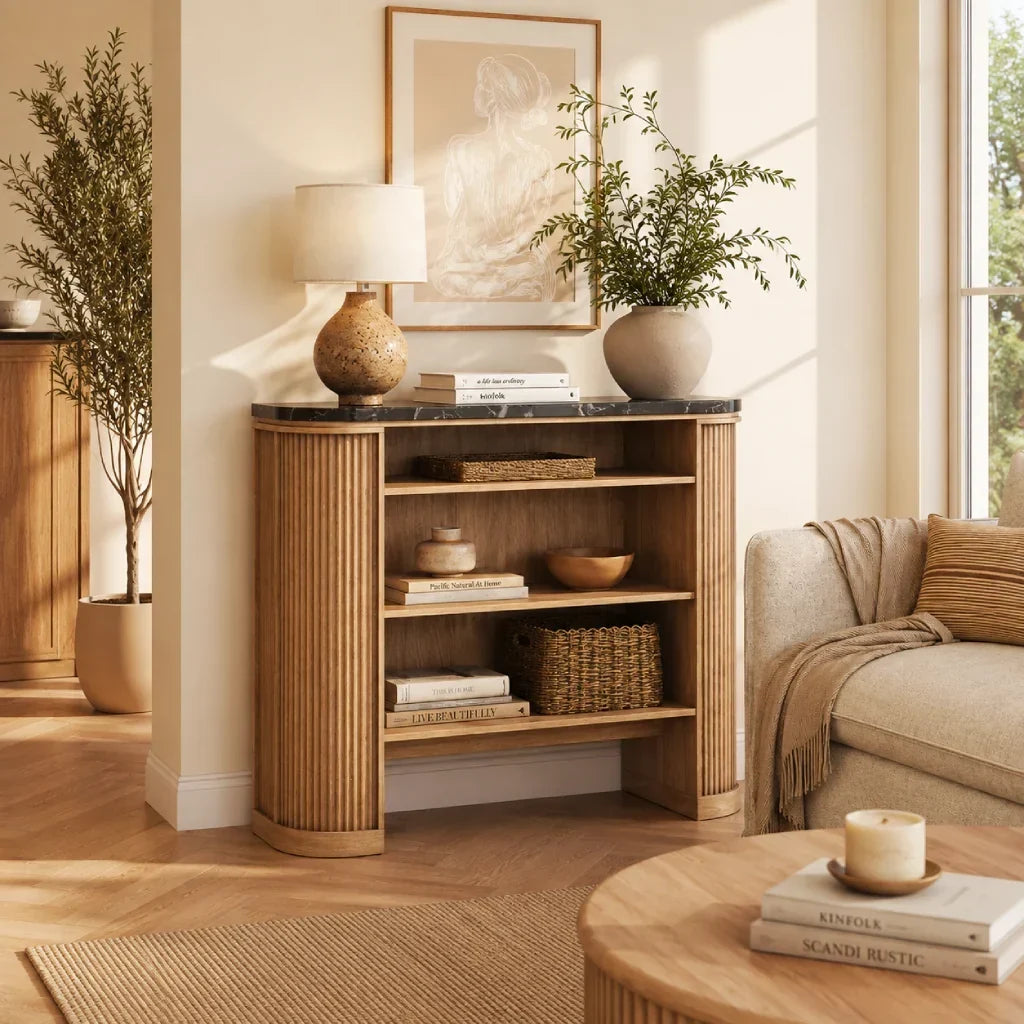
Measure the exact spot where the console will stand. A table can look well proportioned on a product page and still crowd a hallway once it is against the wall, catch an opening door, or look too tall behind your sofa.
Check depth first because it determines how much walking space remains. Once the depth works, compare the table's height with nearby furniture, then mark its full length along the wall or sofa. You will have measurements to shop with instead of a general sense that a table looks about right.
What size works in most homes?
Current furniture guidance clusters around 30 to 36 inches high and 11 to 15 inches deep for contemporary console tables. Length varies more: published ranges run from roughly 24 inches for compact entry tables to 72 inches for long consoles. Use those numbers to filter listings, then narrow them with your room measurements.
Most listings use depth for the front-to-back measurement, but some retailers call it width. Check each dimension diagram before comparing products. If the diagram and written specifications disagree, ask the retailer which number represents depth before you order.
Write down the deepest table that leaves enough room to pass, the height that suits the placement, and the longest span the wall or sofa can take. Rewrite every product listing in that same depth, height, and length order. Cross off a table as soon as one dimension exceeds your limit.
Measure console table depth first
Check depth first for the quickest yes-or-no answer. Measure from the wall to the nearest obstacle, decide how much of that space needs to stay open, and see what remains for the table. A console that fails this check is too deep for the spot, whatever its height or length.
Mark the proposed front edge on the floor, then walk past it as you would on an ordinary day. Swing nearby doors all the way open. Include baseboards, radiators, vents, and registers when you measure. A drawer or cabinet door also needs room to open, so mark that reach before approving a storage model.
| Placement | Measure and test |
| Entryway or hallway | Measure from the wall to the nearest obstacle. Leave room to pass and open each nearby door all the way. |
| Behind a sofa | Measure the open floor behind the sofa. Walk the route, then compare the table height with the stable sofa back. |
| Open wall | Mark how far the table will project from the wall. Approach it from each direction and include vents, radiators, and registers. |
Use 36 inches as a practical starting point for a main walkway. ADA Standard 403.5.1 also requires at least 36 inches on covered accessible routes. Mark the proposed table depth, walk the route, and keep more room where doors, turns, or household needs call for it.

Choose console table height by placement
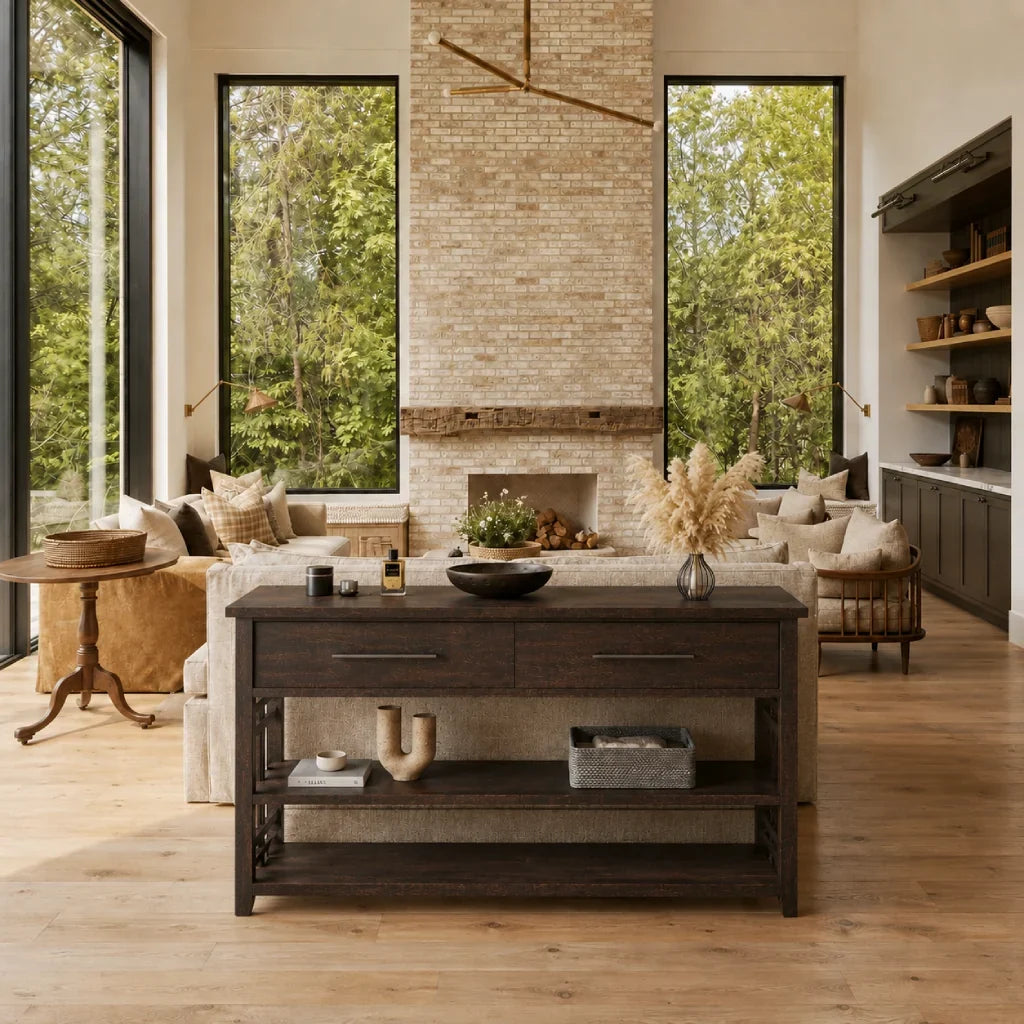
Behind a sofa, compare the console table height with the stable top edge of the sofa back. Start with the tabletop level with that edge or 1 to 2 inches lower. Ignore cushion peaks because they compress, then check the available floor depth behind the sofa.
For an entryway or open wall, judge the height against that wall and any nearby fixed features. Tape the proposed top edge on the wall before you buy. Step back to the main approach so you can see where the surface will sit in the room.
Leave the taped height in place once it looks right from the main approach. You now have a fixed reference for testing the table's length instead of judging both dimensions at once.
Choose console table length after fit
Behind a sofa, start with a console about two-thirds to three-quarters of the sofa's length. Against a wall, leaving roughly 6 to 12 inches open on each side is a useful first pass. Mark the proposed span and view it from the main approach before buying.
Leave some visible space at both ends. The table will look less crowded, and its corners will sit farther from nearby paths or furniture. Test the marked span in the room rather than relying on a general wall-size cutoff. Near a doorway, check whether either marked corner narrows the approach.
Reject any table that fits only after you give up walking space or accept a poor height match behind the sofa. Once those candidates are gone, compare length among the tables that still work. That gives you a maximum length to use when filtering product listings.

Know when to skip the console
Skip the console if it leaves too little room to pass or gets in the way of a door or fixed utility. You may also need a different furniture type if concealed storage matters more than an open surface. Forcing a console into the plan will not give you the storage of an enclosed cabinet.
Hidden storage changes the furniture decision. Use the console table vs sideboard comparison to choose the right furniture type, then run the same depth and circulation checks on the cabinet.
Entry clutter that needs closed daily-drop storage points to entryway modular sideboards. A tight room with a broader storage problem points to sideboards for small spaces. Check the chosen cabinet's dimensions against the route before you buy.
Test the Jagger against your space
The Jagger gives you a concrete set of dimensions to test in your room: 15 inches deep, 44 inches wide, and 34.8 inches high. Belleze notes a 0.5- to 1-inch tolerance due to manual measurement. Those numbers let you test the method against a real product instead of an abstract range.
Leave a little margin if your available space is close to those numbers. These dimensions apply to the Jagger, not to console tables as a category.
- Measure 15 inches out from the wall and mark the front edge. Account for baseboards and other fixed obstacles, then walk through the space that remains. Open nearby doors and walk toward the spot from each direction you use. Rule out the table if it crowds the route or conflicts with a fixed utility.
- Mark a height of 34.8 inches on the wall. Behind a sofa, compare that line with the stable top of the sofa back rather than the cushions. At an entryway or open wall, step back to the main approach and judge the marked height from there.
- Add the full 44-inch span after the depth and height work. Look at the space left at both ends and check the nearby furniture and paths. Keep the Jagger on your shortlist if all three dimensions suit the intended spot.
Once the taped footprint works in your room, review the Jagger 44-inch black marble top fluted console table. Recheck the dimensions and current availability on the product page before adding it to your shortlist. Read the assembly instructions and ask Belleze about any fit or setup detail the listing does not confirm.

Leave a comment
This site is protected by hCaptcha and the hCaptcha Privacy Policy and Terms of Service apply.