


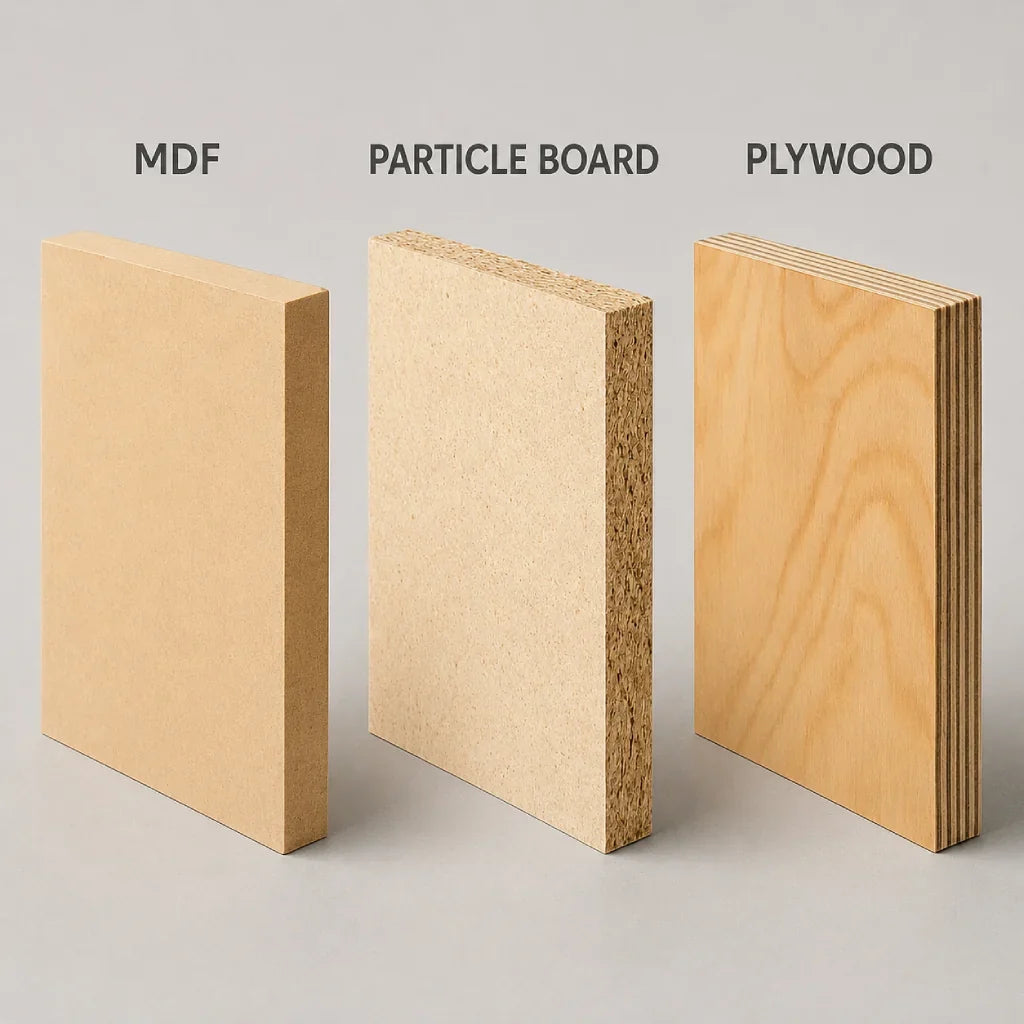
Furniture listings make MDF, particle board, and plywood harder to compare. Finishes can hide the core, hardware changes how the parts work together, and some listings say only "manufactured wood." The material name alone will not tell you whether a bookcase can handle dense storage or whether a sideboard belongs in a damp room.
Start with the furniture's job. Plywood is the safer first choice for long spans, dense storage, or more moisture risk. MDF fits smooth finished surfaces in dry, supported furniture. Particle board fits light storage on short spans in a dry room when lower upfront cost matters.
Where each board fits best
Use the table to choose a board for the job, then compare product specifications. Grade, panel thickness, shelf span, support placement, fastener location, and the listed load limit can change how a finished piece performs.
| Board type | Consider first when | Verify first |
| Plywood | Shelves are long, storage is dense, or moisture risk is higher | Grade, thickness, and listed load limit |
| MDF | A smooth finish matters and the furniture will stay dry | Support layout and care instructions |
| Particle board | Loads are light, shelf spans are short, and cost matters | Listed capacity and hardware attachment |
Furniture type changes which details deserve the most attention. For a bookcase, start with shelf span, support, and what the shelves will hold. For a sideboard, add the finished surface, door and drawer hardware, and exposure to spills or damp cleaning.
A short shelf holding framed photos puts far less demand on a board than a wide shelf packed with books. Compare the support plan and product specifications with the room and storage job you have in mind.

What the board label tells you
Plywood bonds thin wood veneers in alternating directions. MDF combines wood fibers with resin under heat and pressure. Particle board binds wood particles of different sizes with resin or another binder. Use these differences to choose a material category, then use the product's grade, thickness, and support layout to judge the finished piece.
When a listing says only "manufactured wood," look for materials by component: case, shelves, doors, drawers, back panel, and top. Photos cannot identify the core. Apply each material claim to the named part because a sideboard or bookcase may use different boards across its construction.
Compare strength at the component level. For a shelf, use thickness, unsupported span, support placement, and listed capacity. For a door or drawer, inspect where hardware enters the panel and how often the joint will move. The material name starts the comparison; the construction tells you whether that part fits its job.
Why shelf span matters
A shelf's span and support matter alongside its material. As the unsupported span grows or the load gets denser, plywood is the safer place to start. Thickness, center support, and load placement also determine how much work a shelf can handle. Judge a specific product by its listed capacity and support layout.
Fasteners also matter because a connection at the panel face does different work from one at the edge. Check where the hardware attaches, which joints will move during use, and how the shelf is supported. The bookcase dimensions guide helps you compare shelf dimensions with wall space and the items you plan to store.
On the Bijou 71'' Tall 3-Drawer Modern Bookcase, MDF works within a supported cabinet design. Its cabinet and hutch manuals require permanent wall attachment and provide the load limits to use when deciding what belongs on each shelf.
Why MDF works well under smooth finishes
MDF's uniform fiber structure gives it a smooth, consistent surface for paint, wrapped finishes, and machined details. Choose it when the finished face matters and the furniture will stay dry with proper support. Confirm that the visible component you care about is the one the listing identifies as MDF.
The 66" Black Faux Marble Top Fluted Sideboard uses MDF panels in its fluted design. Its manual calls for a lightly dampened cloth, immediate drying, and no bleach, alcohol-based cleaners, or wood treatments on MDF parts. Use those care instructions to judge whether the planned location and cleaning routine suit the material.
Particle board suits lighter storage
Particle board can work for light storage, short shelf spans, and a dry room when upfront cost matters. If you expect dense storage, longer spans, or repeated stress around the hardware, check the product specifications against those demands before choosing it.
A decorative surface does not seal every edge or hardware opening against moisture. Inspect the exposed edges and read the care instructions. A room with regular spills or damp cleaning calls for a closer look at how the product protects the core.
Before choosing by price, compare the construction with the load and room you have in mind. The sideboard buying guide walks through the storage and placement choices that affect that comparison.
Check the product, not just the board
Once a material passes the first screen, compare the whole product. The load limit, shelf span, panel thickness, support layout, hardware attachment, and anchoring instructions tell you whether a specific piece can do the job you have in mind.
- Define the storage job. Decide what each shelf will hold, where the heavier items will sit, and whether the listed capacity covers that plan.
- Match each material claim to the case, shelves, doors, drawers, back panel, or top instead of applying one label to the entire piece.
- Check the room for moisture sources and compare them with the product's finish and care instructions.
- Measure wall width and height, then account for baseboards, trim, door swing, drawer clearance, and walking space.
- Read the assembly instructions for the support layout, wall attachment, hardware placement, and any setup requirement that affects your room.
Compare finalists against the same job. Use the same planned load, wall space, room conditions, and expected hardware use for each piece. Favor listings that give you enough detail to match the stated capacity and support layout to your storage plan.
A piece can use suitable material and still be too large for the room. Use the sideboard dimensions guide to check wall width, openings, and traffic clearance before adding a sideboard to your shortlist.
Questions that affect the choice
Is MDF better than particle board for furniture?
For smooth finished furniture that stays dry and has enough support, MDF is often the better fit. Particle board can work for lighter storage on shorter spans at a lower initial cost. Compare panel thickness, support layout, hardware placement, and listed capacity between specific products.
When is plywood worth the added cost?
Plywood deserves a closer look when shelf spans or loads increase, or when the room brings more moisture risk. Before paying more, confirm the plywood grade, panel thickness, support layout, exposed edges, hardware, and listed load limits for the product.
Why can a shelf sag even when the material sounds strong?
A shelf can sag when its span is too long, the panel is too thin, support is limited, or weight sits in the wrong place. Check the load limit and assembly details, then place items as directed. Ask the seller if specifications do not cover your planned load.
Make the final call
Choose for the hardest condition the furniture will face. Start with plywood for long spans, dense storage, or more moisture risk. Choose MDF when a smooth finished surface matters and the furniture will stay dry with proper support. Choose particle board for light loads on short spans in a dry room when lower upfront cost matters.
Then compare Belleze modular cabinets against your measurements and storage plan. Open each product page to confirm component materials, listed capacity, support layout, care instructions, and wall attachment requirements before ordering.




Leave a comment
This site is protected by hCaptcha and the hCaptcha Privacy Policy and Terms of Service apply.